2. Driver Expectations and Policies
BRLS Code of Conduct
These are our behavioral expectations that support safety, professionalism, trust, and strong
working relationships across the BRLS fleet.
Professional Communication
Respond promptly to dispatch, agents, and customers.
Keep messages clear, direct, and respectful.
Avoid profanity, hostility, or emotional outbursts in work channels.
Timeliness & Reliability
On-time pickups and deliveries are non-negotiable.
Give accurate ETAs and immediate updates if delays occur.
Be ready to roll at planned times and follow your dispatch plan.
Ownership & Accountability
Own your decisions and actions — no excuses, no blame-shiing.
Communicate proactively about issues before they become problems.
Complete all required document submissions, reports, and accountability sheets daily.
Safe Conduct on the Road
Follow DOT, FMCSA, and Landstar regulations at all times.
Drive defensively and avoid aggressive behavior.
Zero tolerance for driving under the influence of any substance.
Load Care & Cargo Responsibility
Understand load requirements before moving.
Maintain securement and trailer condition.
Report damage, delays, or concerns immediately.
Equipment Respect
Treat truck and trailer as business assets.
Perform pre-trip, en-route, and post-trip inspections daily.
Report maintenance issues early — do not wait until failure.
Professionalism at Shippers/Receivers
Be courteous, patient, and presentable.
Follow facility rules without argument.
Represent BRLS and our agents with integrity.
Financial Responsibility
Manage fuel, maintenance funds, and operational costs responsibly.
Follow any BRLS or Landstar policies around settlements and advances.
Keep personal spending from interfering with operational readiness.
Problem-Solving Expectations
Bring solutions or options when presenting a problem.
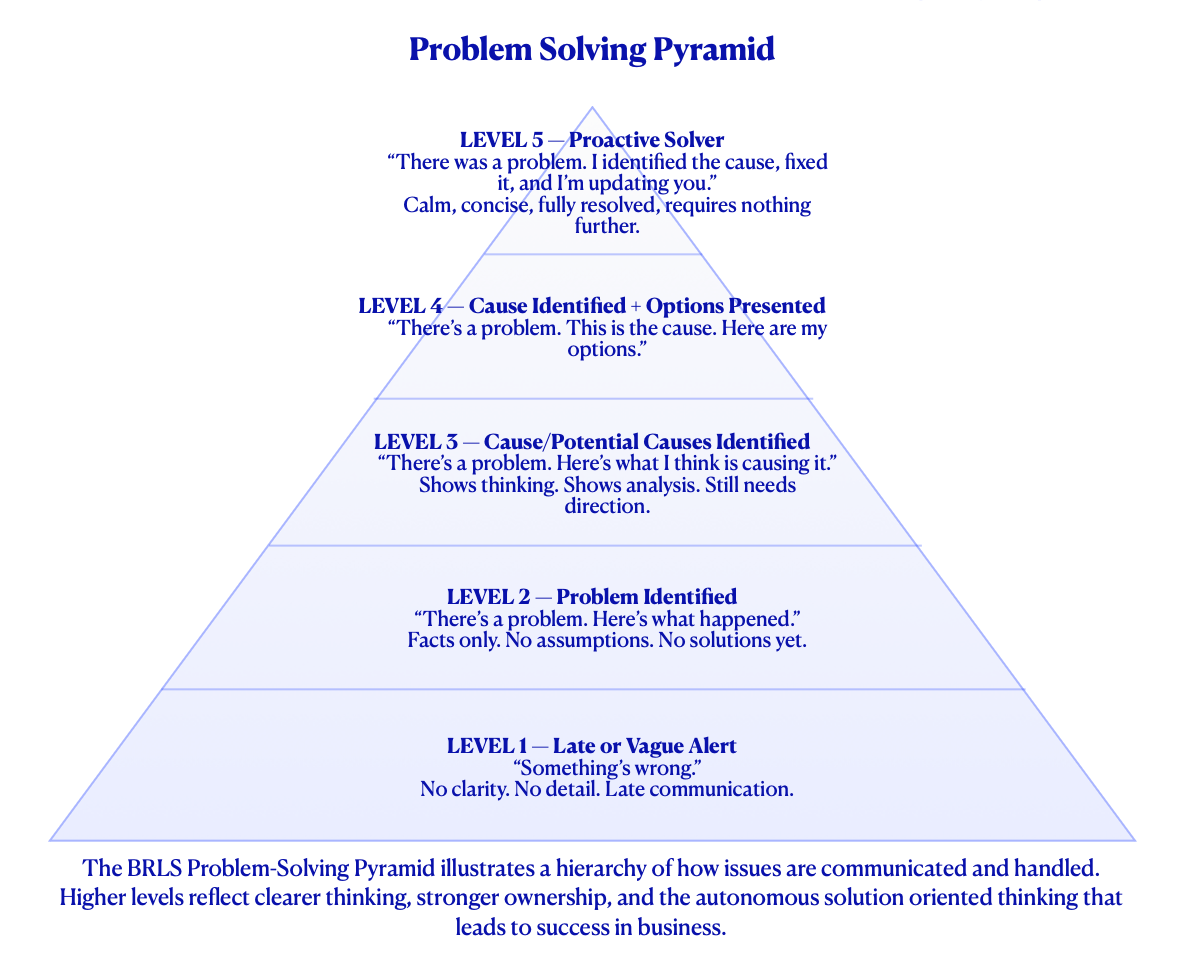
Follow the BRLS problem-solving pyramid (identify → propose → execute).
Ask for help early if you’re stuck.
Zero Tolerance Policies
No harassment, discrimination, or abusive behavior.
No falsifying logs, documents, or communication.
No dishonesty regarding incidents, breakdowns, or delays.
Team Conduct & Culture
Collaborate respectfully with dispatch and other drivers.
Support a positive, growth-minded environment.
Feedback is welcome; negativity without solutions is not.
Consequences
Failure to follow the code of conduct may result in:
Coaching
Performance reviews
Restrictions
Removal from the program (for repeated or severe violations)
What Drivers Can Expect From BRLS
These principles outline how BRLS supports and works with every driver to ensure safety,
profitability, and a strong working partnership.
Clear, Consistent Communication
Straightforward, respectful communication at all times.
Transparency on load details, timing, and expectations.
No guessing — you’ll know the plan and the reasoning.
Fair & Strategic Dispatching
Loads assigned based on availability, performance, freight strategy, and what benefits the
driver.
No favoritism. No hidden agendas.
Decisions are explained when needed so you understand the bigger picture.
Reliable Support
Access to calm, solution-focused help when issues arise.
Guidance on operations, timing, and best practices.
You will not be le to figure out major problems alone.
Respect for Your Time
Efficient communication — no unnecessary calls or texts.
Respect for your downtime when it’s communicated ahead of time.
Stability in planning to reduce last-minute surprises.
Honest, Transparent Planning
Clear rate information, mileage, timing, and constraints.
Expected challenges communicated upfront when possible.
No withholding of information that impacts your decisions.
Consistent Processes
Predictable dispatch workflows and expectations.
Stability in communication and operations — no constant shiing.
Weekly structure drivers can rely on.
Growth & Development
Constructive feedback aimed at improving performance and profitability.
Support with skill-building, communication, and problem-solving.
Opportunities for long-term advancement if the driver wants it.
Professional Partnership
You are treated as a business partner, not a number
Your questions, input, and concerns are respected.
Mutual professionalism forms the foundation of the relationship.
Summary
BRLS commits to fairness, communication, stability, and support.
In return, we expect professionalism, accountability, and proactive communication from every
driver.
Communication Channels
These are the communication channels used at BRLS and the guidelines for when to use each.
Purpose & Intent
Clear communication is critical to keeping BRLS operating safely, efficiently, and at scale.
As the fleet grows, leadership time and attention must be used deliberately so we can
support everyone effectively.
These communication guidelines exist to ensure:
- Issues are routed to the right place the first time
- Information is documented and accessible
- Urgent matters receive immediate attention
- Non-urgent topics still receive thoughtful, thorough responses
Following these channels helps ensure issues are addressed efficiently and consistently.
Signal Messenger App (Primary Communication Channel)
Please acknowledge all announcements from management in all applicable threads with a “thumbs
up” emoji so we know you’ve seen them.
Fleet Message
- Document sharing
- Weekly MPG/CPM Reporting
- General information and announcements
- Policy updates
Truck Chat
- All communication directly with management including:
• Maintenance concerns/reminders
• ETAs and ETA changes
• Load issues or delays
• General questions or discussion inquiries (initiation of high-level questions that will require
phone discussion)
Platform Group
- Securement pics
- Securement questions
- Platform-related issues
BCO Mentoring Group (Mentoring Clients Only)
- Internal networking
- Mentoring program-specific announcements
- Shared learning
Truck Email (Agent Communications)
This is the official line between your truck and the agent.
Use ONLY for communication with agents — not BRLS management.
- Receive rate cons/freight bills
- Arrival/Departures
- ETAs
- Delays
- Questions regarding shippers/receivers
- Securement pictures when requested
“If it isn’t written down, it didn’t happen.”Phone Calls (Escalation and Teaching)
Call when speed matters or when a situation requires immediate support
Initiate a planned discussion for more in-depth explanations
- Use for urgent questions
- Emergency situations
- Serious delays or refusals
- Complex topics that need back-and-forth
- Performance check-ins (when scheduled)
If a problem can cause further issues by waiting: CALL.
If a situation can be clearly explained via message and does not require immediate action, Signal
should be used instead of a phone call.
Zoom (Scheduled group discussions)
Used for structured conversations and training.
Examples:
- Fleet Meetings
- Informational or educational presentations
- Addressing performance concerns
- Visual walkthroughs
Summary:
Use Signal as the default starting point for communication.
Escalate to phone calls when urgency, safety, or complexity requires real-time discussion.
Use email for agent communication and documentation.
Choose the channel that provides the right balance of speed, clarity, and record-keeping.
Clear communication keeps loads moving, prevents misunderstandings, and allows leadership to
support the entire fleet effectively.
Driver Expectations
These expectations ensure safety, professional conduct, efficient dispatching, and strong relationships with agents,
shippers, and receivers. Drivers who consistently meet these expectations experience smoother operations, higher
revenue potential, and fewer preventable issues.
Communication
Drivers are expected to follow BRLS communication standards at all times, including:
- Respond promptly to messages from dispatch and management.
- Send ETAs at required points: loaded & secured, empty, and anytime it changes.
- Communicate delays immediately—before the agent reaches out.
- Keep truck chat professional, concise, and relevant.
Trip & Load Management
Drivers must take full ownership of their runs by:
- Acknowledging booked load assignments
- Confirming all load details upon receipt of rate confirmation (pickup/delivery times, addresses, revenue,
special requirements).
- Planning routes efficiently and safely.
- Monitoring weather, traffic, and potential delays.
- Arriving on time or communicating immediately when timelines change.
- Verifying all load securement requirements in the signal platform group
Securement Standards
- Follow all securement instructions provided by agents, dispatch, and BRLS platform guidelines.
- Send securement pictures in agent email thread (when required) before leaving the shipper.
- Maintain securement equipment in good working condition and notify management when replacement is
needed.
Professional Conduct
Drivers must represent themselves and BRLS professionally by:
- Being respectful with agents, shippers, receivers, and fellow drivers. (Remember who your customer is.)
- Dressing appropriately and maintaining a clean, presentable appearance.
- Avoiding arguments, emotional reactions, or unprofessional comments in any communication channel.
Equipment & Maintenance
Drivers are responsible for:
- Performing pre-trip and post-trip inspections.
- Reporting maintenance concerns immediately.
- Keeping equipment clean, organized, and road-ready.
- Ensuring safety equipment and securement tools are present and functional.
Safety & Compliance
- Follow all FMCSA regulations and Landstar policies.
- Drive within HOS limits without exception.
- Take necessary breaks to avoid fatigue.
- Never operate under the influence of drugs or alcohol.
Administrative Responsibilities
Drivers must:
- Submit required documents (invoices, receipts, PODs, etc.) promptly.
- Track and report MPG/CPM weekly.
- Maintain updated paperwork in the truck (registration, permits, medical card, etc.).
Accountability
BRLS drivers are expected to:
- Take initiative instead of waiting for instructions for obvious next steps.
- Own mistakes, report them immediately, and participate in corrective action.
- Avoid excuses, blame shifting, or withholding information.
- Keep BRLS informed—lack of communication is noncompliance.
Attitude & Coachability
- Approach feedback with professionalism and willingness to improve.
- Ask questions when unsure instead of guessing.
- Participate actively in mentoring, meetings, and performance check-ins.
Reliability & Work Ethic
Drivers must:
- Start their day early enough to meet dispatch and freight requirements.
- Maximize productive drive time within HOS limits.
- Maintain consistent weekly performance and avoid preventable downtime.
ETA Reporting Guidelines
Reliable ETA communication is critical to maintaining smooth load flow, preventing escalation with
agents, and avoiding unnecessary problems. These guidelines explain how to calculate ETAs and
when and how to report them so BRLS can support you effectively.
How to Calculate Your ETA
When calculating your ETA:
• Use actual drive time — # of miles/55mph
• Include standard non-driving time (10 hr break, pre-trips, fuel, 30 minute breaks)
• Consider time of day/rush hour patterns, terrain, known construction zones, etc
• Use weather data if available
• Do not inflate your ETA “just in case”
BRLS expects realistic ETAs based on normal operating conditions.
(See Trip Planning Worksheet for further training for calculating ETAs)
When to Report Your ETA
You must report an ETA during every load at the following times:
1. Immediately After Loading & Securing
Once the freight is secure and you’re ready to roll, send your ETA to the delivery.
2. When Empty
Send ETA to the next pickup (if assigned) or notify dispatch you’re empty and available.
3. Any Time Your ETA Changes
A new ETA is required when your original time changes by:
• 30+ minutes on short runs (< 1 day)
• 1+ hr on longer runs
• If something unexpected happens:
How to Communicate ETAs
ETA communication should be made to BRLS via Signal Truck Chat and to agents via
email unless otherwise instructed.
Use this format:
“ETA to shipper/receiver in [City, State]: [time]”
(Always use time zone of the given city)
Early Arrivals
Early arrivals are encouraged and create strong relationships with agents and customers.
If you can arrive early:
• Confirm early unload possibility with agent (or directly with customer when POC is
given)
• Follow agent/customer instructions
• Notify dispatch
• Maintain professionalism (don’t pressure shippers/receivers)
Delay & Problem Reporting
If anything affects your ETA, notify BRLS leadership and the agent immediately.
Examples:
• Load/unload issues
• Road shutdowns
• Mechanical issues
• Inclement weather
If the situation changes your ETA, we must know immediately.
What Not To Do
• Don’t send vague ETAs (“sometime this afternoon”).
• Don’t give “worst case” times unless specifically asked.
• Don’t wait until the last minute to report delays.
• Don’t say “My GPS Said…” — adjust for YOUR driving pattern.
• Don’t ignore updated conditions (weather, traffic).
• Don’t assume leadership knows — say it clearly.
Summary
Calculate: normal driving + planned breaks.
Report loaded, empty, changes, delays
Communicate in Signal Truck Chat and Agent Email thread